Vegetarian World

Be consistent and look for a nutritionist you trust. Not all the tips here are for everyone, as some are allergic to certain foods.
Suggested list of Vegetarian Nutritionists: http://www.vista-se.com.br/nutricao/
 Água com limão |  Suco Verde |  |
|---|---|---|
 Sucos Saúde |  FRUTICULTURA |  DICAS DE FRUTAS |
 CHIA |  TAPIOCA |  CREPES |
BREAKFAST
During the first hours of sleep, our body enters a process ofRepair,RegenerationandConstruction, which is calledAnabolism,and staysWe fasted for about 8 hours to rebalance ourselves.
When 4:00 in the morning arrives, another process calledEliminationwhich runs until 12:00 pm.
By the time we wake up, we're right in the middle of the elimination process, so all we need to do is collaborate, eating light, easy-to-digest foods that don't require a lot of energy from our digestive system.
Fruits are the perfect breakfast food! They are composed of a lot of water and soluble fibers; in addition to bringing many vitamins, minerals, antioxidants, and simple sugars that give you energy and nutrition at the same time.
They must be consumed at the right point (ripe).
Vegetables are also excellent, as they help with their fibers to eliminate the last residues of the previous day. They can be consumed through green juice.
We were taught that breakfast should be the most complete meal of the day, but in fact, it should be light and frugal. The elements: coffee, bread, butter, cheese, milk, are heavy foods, which fit better in a late afternoon snack.
ABOUT FRUITS IN THE MORNING:
Undoubtedly, the fruit is perfect to start the day, one of the reasons is that our digestive system does not need a lot of energy to process it and, in addition, it offers different benefits for the functioning of the body on a daily basis.
Thus, fruits are considered as the only food capable of making the brain work faster, offering balance with the other parts of the body.
On the other hand, in the composition of various fruits we find the most important elements for the proper functioning of our organism. The largest element in its composition is fructose, composed of approximately 95% water. And when we talk about so much water in the composition of a fruit, we are talking about a “food” capable of cleaning the body and benefiting it.
The problem with fruit consumption is that most people don't know the proper way to do it.
In this case, what should be done is to consume the fruits when we are fasting or when our stomach is empty.
This is the most effective way to consume fruits, since at the beginning of digestion they are not digested by the stomach, but by the small intestine. The fruits pass quickly through the stomach and are directed to the intestine, where they release their sugars.
If, among your routine, you usually consume juice in a box, canned, in glass containers, etc. fasting, it is recommended that you avoid it, as the fact that the juice is in these containers indicates that it was probably heated in its production process, which causes its original structure to become acidic and, in turn, preservatives are added. .
Consuming fruit in the morning will not only make your diet lighter, but will also consume its important natural properties, which will act as follows:
-
They will help the body protect us from heart disease;
-
They will strengthen capillaries, especially those that are more fragile, which constantly cause heart attacks or internal bleeding;
-
Due to their bio-flavonoid content, they will prevent the blood from thickening and clogging the arteries.
When consuming fruits and juices in the morning, try not to consume them too cold, as this causes their components to solidify, slowing down digestion.
After each meal, start implementing a hot tea or, if you prefer, some hot water. This will make the fats “lighter”, which will make their elimination faster and facilitate digestion.
By Malu Paes Leme
Author of the book: "Smart Food"
Do you know KEFIR?

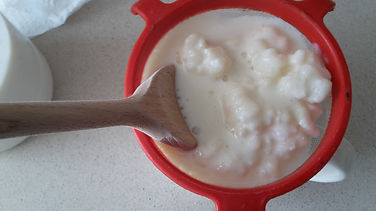
Kefir grain is probiotic(pro=in favor; bio=life) which has existed since the time of the Sumerians, being an ancient medicine that came from Tunisia.
It is a gelatinous polysaccharide grouping that has several microorganisms in symbiosis, and its complexity has not yet been fully deciphered by science.
It looks like yogurt, but its nutritional and therapeutic value is superior! It eliminates pathogenic yeasts from our body.
Professor Dr. Henschlikow, devoted much of his life to the study of Kefir and observed its healing effect for stomach and gallbladder problems, anemia, eczema, thrombosis, diarrhea, constipation, high blood pressure and hepatitis. Kefir prevents the deterioration of waste in the intestine and accelerates convalescence. It can even serve as a substitute for breast milk.
We place the kefir grains (mother culture) in a glass with milk (vegetable) and let it rest at a temperature of 18ºC to 20ºC for 12 to a maximum of 40 hours. Depending on the fermentation time, the milk thickens more or less and produces a different effect.
For ¼ liter of milk, we need a volume of kefir grains corresponding to the size of a walnut. Over the grains, we pour warm milk (approximately 20ºC), without cream.
We close the glass hermetically. As needed, the glasses stay from 12 to a maximum of 40 hours resting in the cabinet. Kefir glass cannot be stored in the refrigerator or exposed to light. It needs to be kept in the closet. However, the strained liquid, without the grains, can be stored in the refrigerator.
Before using the finished kefir, we shake the contents of the glass and strain it (the sieve must not be made of metal). The kefir grains left in the sieve are returned to the glass and again washed down with milk.
Formed by:8 yeasts, 2 acetic bacteria, about 16 lactobacilli, about 9 streptococci/lactococci, folic acid, pantothenic acid, biotin (vitamin B), calcium, carbohydrates, phosphorus, fat, lactase, magnesium, niacin (vitamin B3), potassium , proteins, pyridoxine (vitamin B6), tryptophan, various other beneficial amino acids, vitamin B12, vitamin K.
Kefir was created in antiquity and to this day is developed under conditions that are particularly nearly impossible to replicate in most of our current homes.
To generate kefir grains "out of nowhere" today, it would be necessary to simulate an "environment" conducive to its emergence, as was done over 4,000 years ago, which would be extremely complex and difficult for most of us, so it will be much more economical and practical to earn the beans than to try to do so.
Once you have obtained the kefir grains you can have kefir at home forever, just grow them or even store them in special conditions for long periods when they are not being consumed.
Kefir grains cannot be stored without milk, otherwise they will die.Dry, that is, without milk, kefir only keeps for 48 hours. After this period, it decomposes. A liquid is formed in which a mass that can no longer be used floats.
Kefir can be taken daily. In case of serious illness, take up to one liter a day.
It can also be used instead of sour cream, for dressing salads and sauces.
Observe: Kefir de 12 horas provoca boa digestão Kefir_cc781905-5cde -3194-bb3b-136bad5cf58d_de 36 hours causes constipation
Abkhasia people from the Caucasus Mountains - Southern Russia
The Abkhasia people of the Caucasus Mountains of southern Russia have a reputation for living long and healthy. The government of the Soviet Union claimed that people reached the age of 150, married at 110 and fathered at 136. There are no international epidemiological studies on these data, only Soviet national studies are known.
They live in mountains and go up and down up and down breathing completely pure air, that is, they have very reasonable physical activity.The diet is based on foods grown in local agriculture, with fresh foods, whole grains and various types of nuts.. The day starts with a salad of raw vegetables picked from the home garden. There are different types of nuts in every meal. Despite living in a very cold environment, the diet has less than 2000 calories / day, which in practice means calorie restriction. There, age provides status and respect and elders never retire, remaining active and participating in community activities.
In this region, the ingestion of Kefir, rich in lactobacilli and other beneficial microorganisms for the intestinal flora, discovered by Metchnikoff, Nobel Prize in microbiology, is typical.Milk kefir provides many beneficial effects for human health, including improving the immune system, regularity of bowel function, improving skin texture, preventing breast, prostate and colorectal cancer alongside good health. general disposition.
QUESTIONS AND ANSWERS ABOUT
GRAIN CARE, HYGIENE AND GROWTH OF KEFIR GRAINS
Note: It is interesting to use Kefir with water or coconut milk to make yogurt, for example, since cow's milk is not a good choice.
1) Should I squeeze or squeeze the beans when straining them? NO! You should not squeeze or squeeze the beans with anything to try coar more kefir.This will break them.Most Kefir Grains are pouches and it is important to try to keep them intact. I believe that kefir grain that has not been damaged by squeezing produces more soluble polysaccharide and a thicker, creamier kefir. Breaking or damaging the beans by squeezing will not kill them and when you stop squeezing them they will grow back in pouches (like sago beans).
2) Should I wash my kefir grains after straining them? Washing your beans with cold water before changing the coconut milk is neither essential nor recommended. Using clean fresh coconut milk, there is little chance that any unwanted microbes will grow in the kefir medium. The curds that adhere to the beans form a protective acidic barrier around them, helping to inhibit unwanted organisms far more than when the beans are washed.
On the contrary, washing them removes this curd, exposing them to the environment for the hours necessary for them to be able to rebuild it.
Repeating this process increases the chances of contamination of Kefir Grains. Washing Kefir Grains removes many important microbes from the surface, and possibly protective combinations or possibly undiscovered mechanisms that could be essential for the balance of microflora!
Caucasians have never washed their Kefir Grains.
3) Why did a brown film form on water kefir? Kefir must be shaken once or twice a day to prevent yeasts and acetobacteria from forming colonies on its surface, if not shaken these colonies can be seen as a luminous brown wavy film called "kefir flowers"._cc781905 -5cde-3194-bb3b-136bad5cf58d_Although the initial development of such colonies is not harmful, unwanted fungi can propagate in them, agitation prevents this from happening, possibly due to the increase in available oxygen.
4) Do I need to sterilize my utensils and ingredients? There is no need to do this. Just keep the utensils clean. Just basic household cleaning.
5) When I strain my kefir, the curds stick to the grains making them look bigger, is this normal?
Yes this is normal and ideally you keep it that way without washing them as this not only speeds up your next batch of kefir but the growth rate and grain size seems to increase as well.
6) My grains float, what is happening? Kefir grains normally float a few hours after being placed in the fermentation medium, either due to the specific density of the grain or due to the CO2 gas produced by the yeast. There is also the formation of bubbles around the grains, which causes them to float.
7) What is the growth rate of kefir grains? Under normal conditions, an average daily growth of 5% is observed for milk kefir grains and about 45% for water kefir grains. However, the growth of kefir grains depends on many factors.
In general, they seem to grow faster when:
• are not washed,
• are not "squeezed", ao coar,
• ambient temperature maintains between 18°C to 35°C,
• the fermentation flask is shaken a few times during the day
8) What is the best way to increase milk or kefir production? If you've decided to increase the amount of coconut milk or other medium you're using, you can do this in two ways:
• Increase from 5% to 10% successively in the next batches. If after raising your kefir it doesn't clot all the milk in 24 hours, i.e. you see lots of fresh milk, usually at the bottom of your pitcher, then leave it longer until it's all curdled, before increasing the volume. amount again. In other words, give the beans a chance to regenerate,
• If you decide to increase the amount of milk more than 20%, you will need to adjust the kefir fermentation period, as it can take more than 24 hours to completely clot. Within this regeneration period you will notice that your beans will become more active with each batch, gradually decreasing the time required for fermentation, until they will ferment in 24 hours.
This period varies and can take from 2 days to 1 week.
9) How can kefir grains die? You can accidentally kill your Kefir Grains if:
• subjecting them to excessive heat: hot water, heat sources (stove or heater)",
• adding the wrong ingredients, such as bleach, detergent, etc. or if you decide to make "Water Kefir" or "Herb Kefir", and you add salt instead of brown sugar,
• throw away.
If you let someone help in your kitchen, remember to explain to them that you have these little creatures and you have a great affection for them.
10) Do water kefir grains adapted for milk multiply or not? According to Dominic (the world's greatest expert on the subject), this adaptation can result in non-propagating grains, although the resulting kefir will have a very good taste, color and texture, very similar to traditional Caucasian kefir. After discussion we chose to keep these instructions, because despite Dominic's opinion, many of us made the adaptation successfully and we left it up to each one to adopt it or not.
11) My grains reproduce too much and I have no one else to donate to. What can I do with the surplus? You can consume them pure or mixed with salads, drinks in general, sweets, jellies.
You can also use them in creams and soaps.
However, remember to always leave some grain for donations and also as a reserve, in case an accident happens that destroys your fermentation batch.
Sources and more information: http://www.kefir.50webs.org/index.htm
http://users.sa.chariot.net.au/~dna/kefirpage.html
http://www.curaeascensao.com.br/alimentacao_saude/segredos_curam/segredoscuram13.html